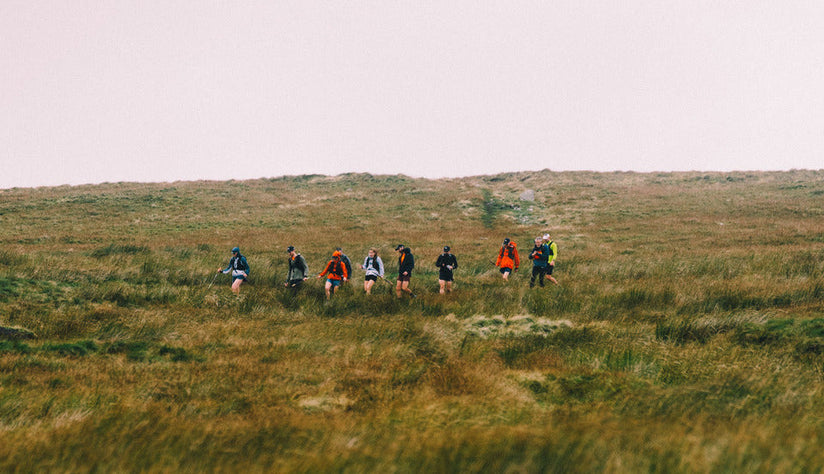
For Chris Cope, the Montane Winter Spine this year was both a natural progression and a personal challenge. Having won the Summer Spine in 2024, he was returning to the Pennine Way in its most brutal winter conditions, keen to test himself again and prove that Type 1 Diabetes imposes no limits. “The Winter Spine was a natural progression… the most beautiful route in England in the most brutal conditions,” Chris reflected. Early moments on Jacob’s Ladder, moving alongside fellow athletes, brought camaraderie and excitement, but the real initiation came on the top of Kinder. “Hundred mile-per-hour gusts by Kinder Downfall had us running at forty-five degrees sideways just to not fall over. Then the wind dropped the moment you moved away from the edge. Within 2km I was forging new paths through deep snow, falling into four-foot drifts. I did not stop smiling whilst at the front on snow plough duties.” The conditions shaped every mile, from rain at the start to ice approaching Stoodley Pike, demanding constant adaptation, focus, and resilience.
Chris’s race was ultimately cut short after a hard fall on ice near Hebden Bridge, forcing him to make the difficult decision to withdraw. “I was hoping the right knee would loosen up. I decided to get through CP1 quickly… and then see how I felt by Cowling and reassess,” he said. The choice to step away, though made safely, left him with mixed emotions: “I am much more disappointed now than I was at the time. Out on the frozen moors, it was a clear and sensible decision… but I am still full of regret.” Even so, the experience reinforced lessons he hopes to carry forward: balancing risk with controlled racing, respecting the conditions, and valuing preparation. On advice for anyone standing on the start line of their first Spine, Chris emphasised the importance of planning and adaptability: “Have a race plan and stick to it until something changes. Be experienced in all conditions, know your kit inside out, and take care of yourself before problems arise.” Despite the setback, he is already looking ahead to the next challenge in January 2027, taking pride in the journey, the training, and the experience of facing Britain’s most brutal race head-on.
James Nobles - Full Spine
55:23:51. Retired at Greg’s Hut around 174 miles in.

For James Nobles, the 2026 Montane Winter Spine was a race he approached with purpose and determination. “I had unfinished business with the Spine this year, and so I’d put everything into my training in the six months prior to maximise my odds of getting to the end competitively,” he said. Starting the race felt almost surreal: “It had consumed so many of my thoughts in the months leading up to it, and then you blink, and you are stood on the start line in Edale. It doesn’t feel real.” The early miles across the Snake Pass, spent laughing and moving with fellow runners, offered a sense of camaraderie, but the reality of the Spine soon made itself known with his first big fall going down Wessenden, and again before Standedge. Running alone in these conditions was when the race truly felt real.
The weather was unforgiving. Wind and fog threatened to blow him off the path, and puddles with hidden ice created treacherous footing. “This is the winter Spine race, it’s what we signed up for, and it’s what I had the kit to help overcome,” James said. He battled through dehydration, dysfunctional quads, and foot issues, managing them as best he could with careful kit checks and support at checkpoints. Cross Fell, in particular, tested him: “At over 800m, it’s a very lifeless and hostile environment, more so when it’s foggy and dark. We were following James Leavesley’s footprints in the snow for miles, exceptionally carefully… the wind picks up, the temperature drops, and to be honest, it’s in those moments where you feel very vulnerable.” By the time he reached Greg’s Hut, his body was ice cold despite hours spent wrapped in coats, sleeping bags, foil blankets, and hot water bottles. “I made a promise to myself to only leave if I could retain my temperature and that moment never came. In the end, the medics made the decision for me given how long I’d been trying to re-warm.”
Despite the disappointment of having to withdraw, James reflected on the race with pride. “I’m writing this a week on now from the race… I’ve now come to feel proud of where I got to and how I got there. I went through a very very low patch… Getting out of that hole and getting moving again was my biggest accomplishment in the race, and something that I’ll take into all other events that I do.” For those taking on their first Spine, his advice is clear: “This is a slow race where miles go by at what feels like a glacial rate… Chip away at them and keep moving forwards as best you can. Eat as much as you can, as frequently as you can, and make sure you drink enough.” With recovery underway, James is already looking ahead to future challenges, including Ultra Trail Snowdonia 100km, the Lakeland 100, and supporting his wife in her training for the Spine Challenger North in June.
Howard Dracup - Spine Sprint North
Completed. 09:16:07

For Howard Dracup, the Montane Spine Sprint North was a chance to test himself and take stock. Over a relatively short distance, he saw it as an opportunity to measure progress against last year’s fitness and set a baseline for what comes next. From the moment the race began, it was clear there would be no easing into it. “I’d say from the onset,” Howard said. “It was a really fast start… coming out of Brown Rigg it’s downhill and onto a tarmac road for a few kilometres. It was game on from the start.”
Conditions played their part, but in a way that made the day enjoyable rather than oppressive. The drizzle eased within the first half hour and the sun came out, with wet but manageable underfoot conditions. “It made for a really enjoyable day out,” Howard reflected. Physically, however, the race delivered an early surprise. While he avoided any mental lows, his body began to seize up far sooner than expected. “It happened as early on as 15–20 miles in,” he said. The toughest section came over the Cheviot summit, where deep snow made the climb and descent energy-sapping and slowed the pace significantly.
As the race wore on, Howard found himself locked into a battle for position, sitting just behind third place through the final third of the course. “I found myself having to push a lot more than I would have trying to catch them,” he said, adding that the chase itself helped keep him focused when fatigue began to build. His approach to pacing was grounded in preparation. Having recced the route, he ran to effort while keeping an eye on his heart rate, adjusting fuel intake when he realised he was moving faster than expected. Race day stayed close to plan overall. “I’d said about 9–9.5 hours on a good day,” he explained. “I thought I might dip under nine, but over the Cheviots it got tough with the deep snow.”
Reflecting on the experience, Howard came away with renewed confidence. “It taught me that I can run a bit faster when I want or need to, and that maybe I should back myself a little bit more going into races.” For anyone lining up for their first Spine, his advice is simple: “Take your time, enjoy it, learn from it.”
With a busy season ahead, the Spine Sprint North marked a strong start to the year, offering clarity, confidence, and valuable lessons to carry into the races and challenges still to come.
Tasha Brook - Sprint North
Completed. 12:19:35

For Tasha Brook, the 2026 Montane Spine Sprint North was about stepping into unfamiliar territory. “This year the Winter Spine was about doing something completely different and deliberately stepping outside my comfort zone,” she said. A newcomer to ultrarunning, Tasha was curious to see how her mountaineering experience would translate to long-distance trail racing. The race quickly became real within the first kilometre, when she left the road and river trail to join the Pennine Way and encountered a knee-deep bog. “There was no way around – you had to go through. I saw runners in the distance, had a brief moment of ‘how did they cross that?’, and then realised I had no choice but to follow. That was the moment the race truly started.”
The conditions were challenging, with limited daylight from the midday start and harsh weather later in the race. “Once night fell, especially heading up towards the Cheviot, conditions became properly hostile – minus temperatures, fog, wind and snow. It was brutal and very Spine. I’d expected that, and mentally prepared myself for it during the easier hours earlier on.” Despite this, Tasha found her mountaineering background came into its own, particularly on the climbs. Taking second place in the women’s race was a bonus; she hadn’t even realised she was in that position until halfway through. “Physically, I didn’t expect my mountain experience to translate as well as it did… Mentally, the race gave me a huge amount of confidence. It made me believe in myself for bigger events and left me excited for more ultrarunning experiences.”
Tasha reflected on what the race taught her about herself. “It reinforced how powerful stepping outside your comfort zone can be. You gain a completely new perspective on what you’re capable of – one you simply wouldn’t have access to if you didn’t choose to do the hard, unfamiliar thing.” She also learned the importance of running her own race, both in pacing and mindset: “There’s a real beauty in expedition-style ultramarathons where the experience itself is the reward.”
The latter stages of the Sprint North were particularly testing, with snow, ice, and fatigue compounding the effort. “The final 10km into Kirk Yetholm… you can see the town lights, but the dead ground hides it repeatedly, so you think you’re nearly there only to find yourself climbing again. Mentally, it’s a real test.” Yet it was during the climb to the Cheviot that she realised she could handle the distance and conditions: “Despite the conditions, I felt excited for it. I’d told myself this was the section that would feel familiar – my terrain. That mindset shift made me realise I’d already covered most of the race and was ready to take on what was left.”
Looking forward, Tasha sees endurance as more than physical capacity. “It reminded me that real growth comes from committing to yourself long before the start line… Committing to myself in that way has built a deeper confidence than any result ever could. It’s given me confidence to step into unfamiliar spaces and trust my ability to adapt. Endurance goes beyond physical capacity; it’s about the willingness to commit, adapt, and continue showing up when you don’t know how it will unfold.” With her eyes on future adventures, including Scottish winter mountains, trekking in Nepal, and high-altitude mountaineering in Kyrgyzstan, she is ready to build on this experience and continue growing as an endurance athlete.